
Meet Brooke Grindlinger, 2026 AdaMarie Expert
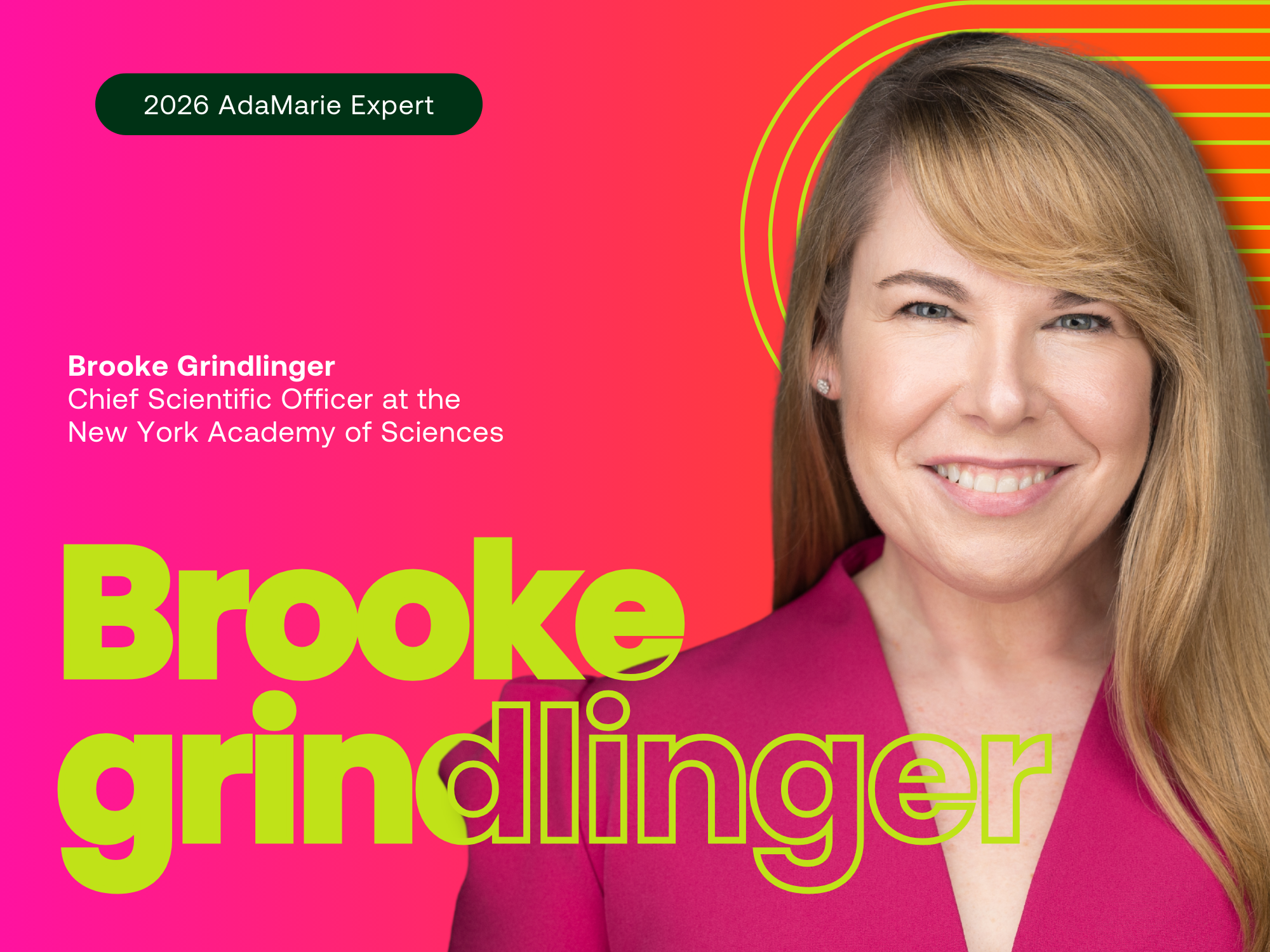
Careers in STEM don’t have to stay confined to a single discipline, role, or lane to be meaningful. Brooke Grindlinger has built her career by following where impact was needed most and by designing systems that help others thrive along the way.
Brooke is joining us as a 2026 AdaMarie Expert, and we’re excited to feature her across upcoming conversations and programs focused on career growth, stretch opportunities, and navigating leadership in science-driven environments. As Chief Scientific Officer at the New York Academy of Sciences, Brooke works at the intersection of research, philanthropy, and innovation, helping shape how science responds to society’s most complex challenges.
In her work and in her upcoming AdaMarie conversations, Brooke brings a rare perspective: deep scientific training paired with a systems-level view of how careers, institutions, and opportunities actually function. If you’re curious how curiosity, courage, and strategic pivots can open unexpected doors in STEM, keep reading.
Meet Brooke Grindlinger!
Major & Minor – If you went to college!: Microbiology
Field of Work: Science philanthropy and nonprofit leadership
Expertise In: Microbiology, scientific publishing, science communication, research funding and prizes, interdisciplinary science programs
Current Company: The New York Academy of Sciences
Job Title: Chief Scientific Officer
One-liner about what you’re working on: How AI can transform everything from STEM education to drug discovery and materials science, and how to deploy it responsibly without slowing innovation.
Currently geeking out over: Watching the medical drama "The Pitt" and turning it into a personal game show by shouting out the definitions of medical acronyms before the characters explain them. DKA: diabetic ketoacidosis! MRSA: methicillin-resistant Staphylococcus aureus! It’s deeply satisfying, mildly unhinged, and I’m 100% sure it’s driving my family nuts.
STEM hero (alive or dead!): Dana Scully from "The X-Files." Her portrayal as a brilliant, skeptical, no-nonsense physician-scientist literally changed the real world. The Scully Effect showed that watching her on TV increased the number of women who went on to pursue STEM careers. I was one of them. If I must name a real-life hero: France A. Córdova — American astrophysicist, first woman and youngest person to serve as NASA’s Chief Scientist, former Director of the National Science Foundation, and former president of Purdue University. I had the fortune to interview her a few years ago and was struck not just by her accomplishments, but by her authenticity, humility, and willingness to talk openly about uncertainty and self-doubt.
STEM superheroes aren’t born. They’re made.
Be your own best advocate. Don’t assume someone else will speak up for you in rooms you’re not in. Not everyone gets that mentor or ally, and that’s okay.
Tell us about your professional journey – how did you get where you are now?
I started my career as a microbiologist, working on ways to improve diagnostics and vaccines for tuberculosis. It was narrow, deep work, and I loved the rigor.
Straight out of grad school, I made my first big pivot and joined "The Journal of Clinical Investigation," which publishes original research and commentary across the spectrum of human pathophysiology and disease. Overnight, I went from focusing on one pathogen to tracking the frontiers of discovery across nearly all of biomedicine. It was an incredible time—bringing new research to global scientific, medical, and patient communities and building a network of scientists leading innovation across fields.
As a scientific journal editor, I often attended conferences at The New York Academy of Sciences to scout compelling unpublished research and invite submissions, and those conversations eventually opened the door to my next chapter: joining the Academy to lead its scientific conference portfolio. Over time, that work expanded beyond the life sciences to include the physical sciences, computer science, engineering, and sustainability.
Today, as Chief Scientific Officer, one of the most meaningful parts of my role is leading and growing our global prize programs, which support early-career scientists in the U.S., U.K., Israel, and India as they bring discoveries from bench to market. I also work with leaders across academia, industry, government, and philanthropy to help shape how science tackles society’s hardest problems.
I’ve learned that careers are built less by perfect plans and more by curiosity, relationships, and the courage to follow where your skills are needed next. That’s also why I’m deeply committed to building pathways and support systems for early-career scientists, especially women, who are still figuring out which doors are open to them.
We’re also curious to know your personal story and upbringing. What has made you “you”?
I grew up on a small farm in rural Australia, raised by a single mom who taught me independence by example. I was the first in my family to have the opportunity to go to college, and I didn’t see many examples of the paths I would eventually take. That upbringing gave me a strong sense of self-reliance and a habit of making the most of every opportunity. It took me years to understand how that shaped my ambition, my work ethic, and how I show up as a leader. The girl who fed horses before school never imagined she’d one day speak at the United Nations, and it’s a reminder I carry with me that your origins don’t have to limit your trajectory.
We know that real life isn’t a smooth and linear journey. What was your initiating moment that led you to your calling - can you tell us about that moment, what helped you moved forward, what you learned/discovered?
I started my career at the lab bench and loved the puzzle-solving and discovery, but I struggled with how far removed that work felt from people’s lives. I also didn’t see many women ahead of me in the roles I was supposed to aspire to.
The turning point came when I realized my impact wouldn’t come from making discoveries myself, but from building systems that help many scientists thrive. That insight led me to leave bench research for the science nonprofit sector.
Today, I do science by building programs, prizes, and platforms that support thousands of scientists across career stages and fields.
I’ve learned that you don’t always find your calling all at once. Sometimes you have to listen to what keeps pulling you forward and give yourself permission to follow it.
You’re a working person in a performance-driven industry. Where do you find balance?
I’m still learning not to let my role or job title define my identity or self-worth. I love the impact of my work, but I don’t live to work. I work so I can travel, see the world, and experience life with the people I love. That perspective helps on the hard days, because every role has its less-glamorous parts (hello, financial forecasts and KPI reporting). I’m intentional about focusing on the work that fuels my joy, curiosity, and growth, and about creating more of it when I need to. That’s my balance.
If you were a part of the human body, what would you be?
The frontal lobe: obsessed with order, addicted to lists, and curating a convincing sense of control.
We’d love to feature your work! How can we spread the word about what you’re doing? Some examples you might want to share:
You can watch my 2024 commencement address at New York Medical College, where I talk about building a meaningful career in science beyond linear paths, and explore my writing and podcast appearances on The New York Academy of Sciences’ website. If you’re a scientist, engineer, or STEM professional looking to grow your network, knowledge, or skills, I’d love for you to join our global community at nyas.org.
Do you have a favorite motivational quote or song?
Before speaking gigs, I have a hype playlist for that moment when nerves meet anticipation. On repeat: “Roar” by Katy Perry and “Thunder” by Imagine Dragons. Instant swagger. Guaranteed smile.
Any final advice for early-career STEM professionals?:
Be your own best advocate. Don’t assume someone else will speak up for you in rooms you’re not in. Not everyone gets that mentor or ally, and that’s okay. Learn to do it yourself. And when an opportunity safely scares you, take it. Growth lives there, and you’ll often discover you were far more ready than you gave yourself credit for.
As a 2026 AdaMarie Expert, Brooke will be leading conversations and events throughout the year focused on navigating stretch opportunities, career pivots, and leadership in science-driven spaces—without losing sight of balance, values, or long-term impact.
If you want to learn from Brooke live, registration is open for upcoming AdaMarie LinkedIn Lives and programs. Participants gain access to expert-led conversations, practical insight, and a community designed to support sustainable growth at every career stage.
