
Meet Priya Abiram, 2026 AdaMarie Fellow
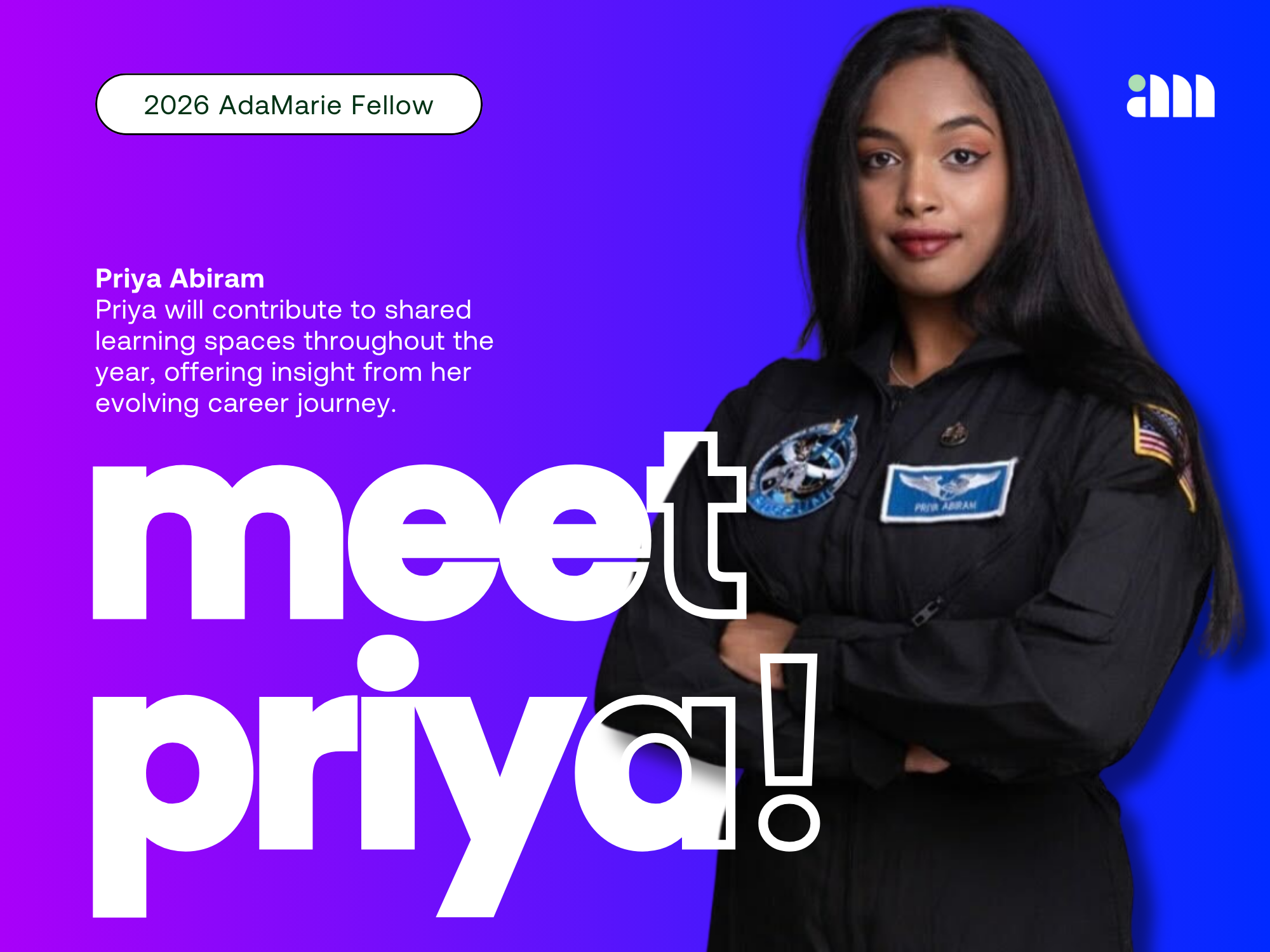
Meet Priya Abiram, a 2026 AdaMarie Fellow whose work sits at the intersection of aerospace engineering, human systems, and exploration. Trained as an aerospace engineer and driven by curiosity about how people perform in extreme environments, Priya’s journey spans spacecraft systems, life support design, microgravity research, and astronaut training.
Her path reflects a deep commitment to rigorous engineering, thoughtful leadership, and expanding what’s possible in STEM — not just in space, but here on Earth.
Throughout her Fellowship, Priya will contribute to the AdaMarie community through workshops and shared learning spaces, bringing an early-career perspective grounded in exploration, persistence, and curiosity.
In this Mirror, Priya shares how engineering curiosity, mentorship, and a willingness to lead without a roadmap shaped her path into aerospace, human systems research, and exploration at the frontier of what’s possible. Keep reading to learn how she thinks about growth, risk, and designing a career that reaches beyond the expected.
Meet Priya Abiram!
Major & Minor – If you went to college!: Aerospace Engineering at Cornell University
Expertise In: Design Engineering & Bioastronautics Research
One-liner about what you’re working on: Astronaut Life Support System Design
Currently geeking out over: Women's Health Tech and innovation!
STEM hero (alive or dead!): Kalpana Chawla
Tell us about your professional journey – how did you get where you are now?
My path has always lived at the intersection of engineering, human systems, and storytelling. I trained as an aerospace engineer, but I was drawn to more than just rockets. I was fascinated by people in extreme environments and by how technology shapes human performance. I pursued hands-on work across spacecraft systems, human factors, and life support, alongside flight training and microgravity research. Over time, that curiosity grew into leadership roles, mission opportunities, and the chance to build new platforms that translate frontier research into real-world impact.
I am an aerospace engineer, pilot, and astronaut-in-training with experience in human systems and spacecraft engineering at NASA, Blue Origin, VAST, Inversion Space, and Boeing. I hold a B.S. and M.Eng. in Aerospace Engineering from Cornell University and have worked on spacesuit technologies, microgravity flight missions, and analog astronaut expeditions. My work spans assistive technology, renewable energy, and space-for-Earth applications, with a focus on designing systems that improve human health and performance in extreme conditions.
Beyond engineering, I am deeply committed to education and equity in STEM. I have organized global seminars that have reached more than 3,500 students across 10+ countries, and I have led initiatives supporting underrepresented communities in aerospace. At every stage, my work has been driven by a desire to build rigorously, lead thoughtfully, and expand who and what the future of aerospace is built for.
We’re also curious to know your personal story and upbringing. What has made you “you”?
At first glance, I fit into the stereotype: A studious, quiet South Asian girl focused on STEM at an academically competitive school. However, look closer, or more accurately, look up in the sky, and there I am, a pilot, passionately flying a Cessna172.
My school day may seem to be surrounded by exactness: rational formulas, unyielding facts, and annotated lab report rubrics. Yet I find freedom and liberation when I defy gravity and break the laws of nature. I feel a sense of buoyancy when I recover from an engine failure at 4,000 feet. I find power and elation when I defy gravity.
While friends freak out over an upcoming test, afraid that they will “crash and burn,” I try to put things in their proper perspective for them, pointing out with a bit of humor that an error on my part at 20,000 ft, and I could literally “crash and burn.”
The novelty of flying through the clouds never wears away. Along with the peace and tranquility of the empty sky comes a profound amount of alertness- constantly checking all dimensions of the plane and the emptiness of the horizon. Looking down from a high altitude, I don’t see boundaries separating states, cities, or even people. I forget about the daily stresses of life; it’s just me, a small dot in an endless sky.
When my head isn’t literally and figuratively in the clouds, I may be descending thousands of feet as a scuba diver. I love to immerse myself in a world of vibrant colors and exotic life in every crevice of the reef. Although I know that in this environment, I am the alien species, in the liquid world, I find freedom and tranquility, mixed with excitement and the stimulation of discovery. I love the constant sensation, the feeling of weightlessness, and freedom of movement. I am regularly inspected by the intense gaze of marine life, unhurried and calm. It is the kind of encounter that is so immediate and thrilling that time and action seem compressed.
Witnessing the depths of an ocean and the edge of the horizon has changed my perspective of Earth, and no two views are ever the same. I realize that there are more dimensions and vast expanses to explore in life than what lies immediately in front.
When I’m asked what I do for fun, I feel a great sense of pride in telling people I am a pilot, scuba diver, and explorer. More than just a hobby, it instills a real sense of humility by making me realize just how small I am in the boundless and infinite world around me.
I enjoy breaking stereotypes and inspiring young girls as I rise above social and cultural norms. I take pleasure in sharing my unique perspective of our planet, redefining our limits, and inspiring others about their passion.
I am grateful for the inclusive communities in both worlds - in such a melting pot, I rejoice in the interactions with everyone, open and sharing this passion. Usually the youngest in the room, I fondly recall the feeling of equality instead of being seen as a girl, South Asian, or teen.
While my daily routines are structured and planned through to-do lists on post-it notes that engulf my room, I embrace the spontaneity and risk of unpredictable (erratic) ventures to find out how far I can go. Regardless of whether I choose to soar or dive, I am always in awe of the life of a bird or a fish; it gives a whole new meaning to the word “possibility.”
As a bonus, I am fond of freaking my parents out (they prefer a peaceful vacation at the beach) by sharing heart-pounding moments from an in-flight emergency or a too-close encounter with a very hungry shark.
We know that real life isn’t a smooth and linear journey. What was your initiating moment that led you to your calling - can you tell us about that moment, what helped you moved forward, what you learned/discovered?
Two things helped me move forward: mentors who trusted my judgment, and learning to trust myself when there was no existing roadmap. I learned that progress rarely comes from fitting into existing boxes. It comes from designing new ones and being willing to stand behind them.
I learned a lot from my mentor in the Air Force Auxiliary (Civil Air Patrol). She shaped a big part of who I am today.
I approached the Cadet Commander: Cadet Colonel Vergara. Despite her high rank, position, and authority, she always remained grounded to her roots - humble and working to help others succeed. I aspired to be the same and hoped to treat everyone as equals to succeed together.
A few years later, I became the next Cadet Commander. By embodying the Colonel’s dedication and passion, I transformed unenthusiastic Aerospace and STEM lessons to ones that fostered innovation, featured in the National Conference, awarded NHQ grants, and served expertise to uplift the nation as the founder of the ‘Small and Multiple Aerospace Research Teams’ Program. Amazed by our impact, the Air Force Auxiliary National Director of Aerospace Education paid us a visit and praised our enthusiasm and creativity in national newsletters.
Due to the Colonel’s consistent mentorship, I learned to operate with a high degree of humility, and that allowed me to nurture a successful team. Just like how she helped me mature in all aspects of character, I ran at the back to push forward, stranglers and sprinted to the front to motivate the team forward.
I rose from learning to take care of myself to mentoring 120+ cadets: I gave the team my full attention, held myself accountable for their failures, and was selfless. It has been an honor to attain her rank, position, and authority; the lessons I learned from the Colonel will stay ingrained as I choose to raise the bar and build the next generation of leaders.
You’re a working person in a performance-driven industry. Where do you find balance?
Balance, to me, is not about slowing down, it’s about alignment. I choose work that feels meaningful and collaborators who value integrity. Flying, running, and spending time with my family and close friends recharge me and push me to be a better version of myself.
Let your geek flag fly! You choose one: if you were a part of the human body, outer space, or a scientific process, what would you be and why?
Captain Kirk! I enjoy being on the final frontier (Unintentional homage to Captain Kirk), of the unknown, disproving theories developed on Earth, and applying innovations to curate solutions to tomorrow’s problems. I aspire to land on Mars and serve as a bridge for the next generation of explorers to extend our species farther than we have imagined.
Each milestone we push through and each planet we discover brings elevated capabilities and positive innovations for mankind here on Earth. This process of constantly learning and discovering to develop solutions to tomorrow’s problems in a universe left to explore is what excites me about making an impact through aerospace engineering.
Realizing that 95% of dark matter that makes up space is still not understood, I want to try to understand the cosmos and wrap my head around the idea of a universe that extends to infinity while simultaneously collapsing all of matter and time into a singularity through a black hole. It is this duality that brings the boundless freedom to explore.
The ability to conquer areas outside our comfort zone excites me not just to build civilizations on other celestial bodies, but also to bring our planet to a common vision.
Through the journey, I look forward to leaving a mark by showing the next generation, and our future alien friends, what our species did with our time here.
We’d love to feature your work! How can we spread the word about what you’re doing? Some examples you might want to share:
I've joined Operation Period as their Director of Research and Innovation for the Redshift Lab. Through the lab, we are testing a space-enabled biomedical research platform advancing menstrual health in microgravity, with direct implications for women’s health on Earth.
As we move toward our next R&D and flight milestones, we are exploring mission-aligned brand partnerships, particularly in fashion, beauty, and wellness, with organizations interested in supporting rigorous science, human spaceflight, and women’s health innovation.
This work sits at the intersection of aerospace engineering, medicine, and design, and we are excited to collaborate with partners who believe the future of space and healthcare should be inclusive by design.
If your brand is interested in shaping how women’s health is represented in frontier environments, I would love to connect.
Do you have a favorite motivational quote or song?
My mentor guided, "When passion becomes so deeply rooted, it becomes persistence."
Any final advice for early-career STEM professionals?:
Each ‘no’ is one closer to that one ‘yes’ you need. Believe in yourself even if no one else will, and don't be afraid.
Priya’s journey reminds us that careers aren’t built by fitting neatly into existing boxes — they’re built by asking bigger questions, trusting yourself in uncertainty, and designing new paths forward.
As a 2026 AdaMarie Fellow, Priya will contribute her perspective on engineering, leadership, and exploration throughout the year. Follow along to learn from her work at the intersection of aerospace, human systems, and possibility — and to see how she continues pushing the boundaries of what’s next.
