
Mirrors: Naome Jeanty, Salesforce Administrator
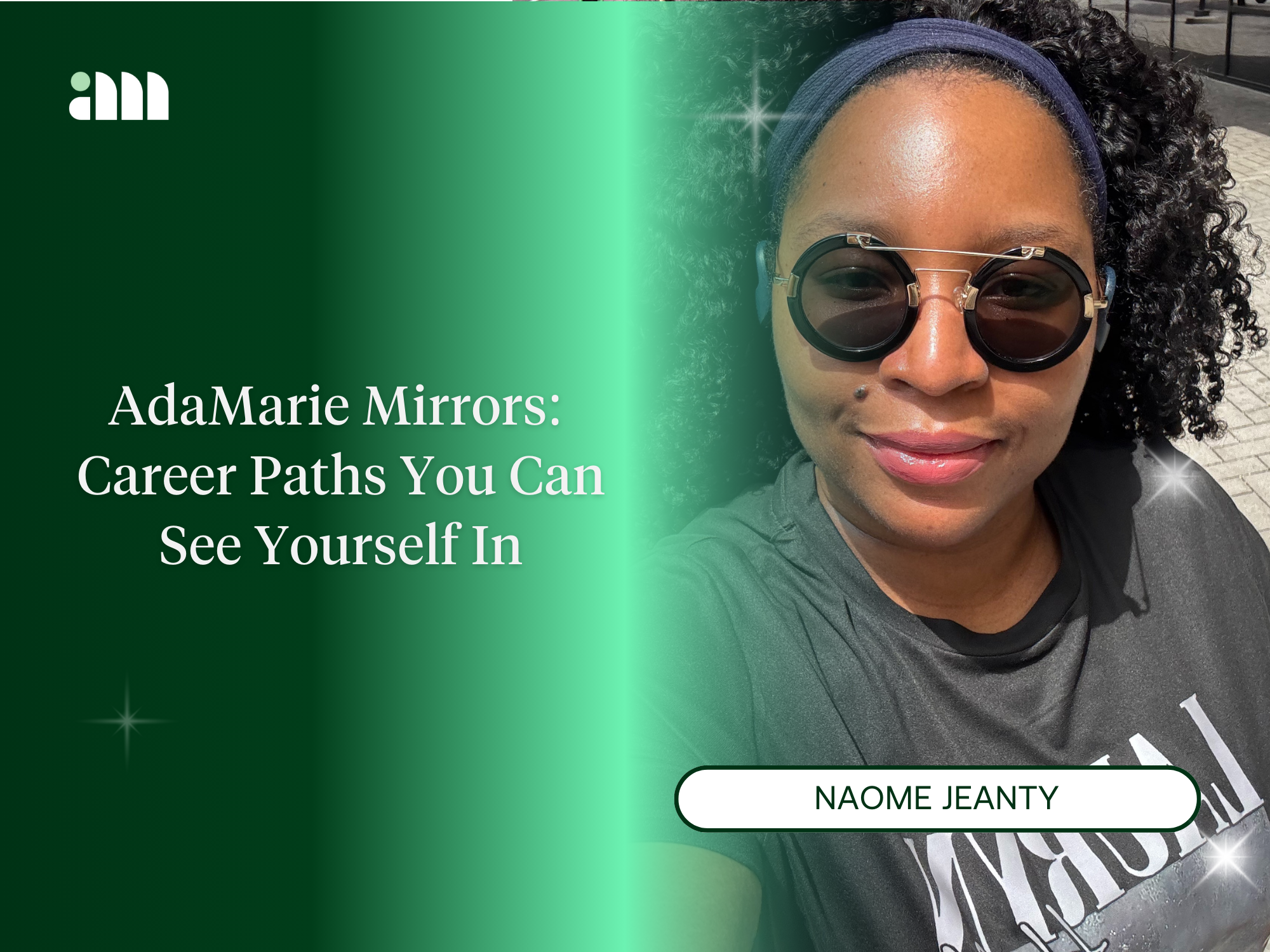
The AdaMarie Mirrors reflect back to us the many roads (often winding, never smooth) to success! Real stories to see yourself reflected. At first, you’ll see Naome in this mirror, but eventually, we hope you’ll see yourself.
Welcome, Naome Jeanty!
Naome works at the intersection of technology and public service, supporting nonprofits with the data infrastructure they need to scale impact. In this conversation, she shares how she moved from policy and program evaluation into Salesforce and nonprofit tech, what it means to build mission-aligned systems, and the advice she’d give to early-career STEM professionals finding their way.
Naome Quick Facts
Undergrad major: Political Science
Graduate school: Master of Public Administration (International Development Policy)
Current work: Salesforce Admin supporting a national bail fund + other nonprofits
Current Company: The Bail Project
Currently geeking out over: “holy grail” staple seasonings across cultures
Motivational quote: “Embarrassment is the price of entry.”
First things first, can you tell us about your major and minor in undergrad?
A: Yes. In undergrad I was a political science major.
And did you continue school after? What else did you study?
A: Yes. I have a Master’s of Public Administration with a focus on international development policy. I did that right after my bachelor’s.
And what field of work are you in right now?
A: I am at the intersection of technology and public service. I support nonprofits with their data infrastructure. Internally, I work with a nonprofit. We’re a national bail fund, and I am their Salesforce admin. So I build out, plan, and maintain their Salesforce infrastructure, but also work with other nonprofits on that as well.
If you had to describe your expertise, what do you have expertise in?
A: Definitely the nonprofit industry, policy and program evaluation. I actually started my career doing policy and program evaluation work. When the pandemic hit, I was an evaluation director, and one of the things that was taking up a lot of my time, and the time of the nonprofits I worked with, was their transition into going digital. Many of them were still using paper forms. A lot of times what happens when a nonprofit is just starting and beginning to scale is they get these big grants, funding, or fiscal sponsorship, and while they’re scaling, it’s a requirement of many of these grants for them to take on some piece of technology. I ended up continuing to move away from just research and spending more time on the data infrastructure piece. I saw a huge gap in the industry where there are not a lot of folks who truly understand nonprofits and also understand the technical side of data infrastructure.
I officially transitioned about five years ago to do Salesforce and data infrastructure work more specifically. So my expertise is research, data, program evaluation, nonprofit operations, and Salesforce. I’m Salesforce admin and architect certified, and I have a lot of expertise in other CRM’s as well.
A lot of people don’t understand that there are pathways for scientists and technologists in the nonprofit sector. Can you say something about some of the misconceptions about tech and nonprofit work, or what opportunities are available for people?
A: For sure. One misconception is that you’re going to get where you’re going really fast. If you want to be in tech, those big roles like architect or senior developer take time. You have to hone your skills. Technology is not an industry you can hop into and master quickly. You have to be along for the ride. Another misconception is that you’re going to get a certification and then immediately get a job. Absolutely not. Certifications are great, and continued learning is necessary, but they don’t guarantee anything. You have to understand what organizations need and be able to add value and translate that into a substantial return on investment.
A misconception about nonprofits in particular is that the work is easy because there’s “no profit.” That’s absolutely untrue. Nonprofits need money, a lot of it. The work is expensive and complex. If you’re thinking about public service, whether nonprofit, philanthropy, or government, understand that money matters and the work is not simple.
Can you give me a one-liner about what you’re working on right now?
A: I’m working on figuring out ways to translate how good stewardship of technology can multiply impact for nonprofits. It’s all about leveraging technology so you can multiply donations, grants, and overall impact.
And can you name something that you’re currently geeking out over?
A: My partner and I are watching a Korean cooking show on Netflix, and I’m geeking out over the idea of holy grail spices across cultures. In Korean cuisine, they use different jangs. In Haitian culture, we have epis, which is our holy grail. And in American cooking, there’s the celery, carrot, onion trifecta. I’ve been geeking out over cultural practices and staples when it comes to seasoning and cuisine. I don’t cook a ton, but I’m nosy and want to know what people are doing.
Who is your STEM hero?
A: I worked with a woman who was a Salesforce architect. Her name is Aubrey. We were working on a very difficult project. She came in late and cleaned up so much of the mess and discord. She always approached things holistically and never had an issue training or educating others. As an architect, people often feel like they can’t ask them questions, but she was always available. I learned so much from her about learning, growing, and being organized. She’s my technical hero for sure.
Tell us about your professional journey. Where did you start and how did you get where you are right now?
A: I started as a young New York City kid in Queens who needed help. I got involved with a nonprofit called Urban Dove that paid students stipends to hold after-school programming. I was struggling in school and went to a very competitive high school, traveling two hours each way. The nonprofit helped me with motivation, time management, and college applications. That was my first realization that nonprofits were a whole ecosystem. I continued volunteering and working with nonprofits throughout college. I initially thought I’d go to the FBI and become a lawyer, but nonprofit work resonated with me. I earned my Master’s in Public Administration at NYU and stayed in the nonprofit sector because I’m passionate and come from impacted communities.
I’ve worked in juvenile justice, criminal justice, public health, and with children who lost parents. I didn’t have a concrete plan. I followed what I was learning, what employers needed, and what I cared about. I found evaluation work because a nonprofit needed it, and I learned as I went. Salesforce came into my life because I needed good data systems to do evaluation work. I kept iterating based on demand, education, passion, and what paid well, especially living in New York.
I didn’t have a concrete plan. I followed what I was learning, what employers needed, and what I cared about.
What has made you you?
A: At the core, I’m deeply passionate and curious. I love learning and going down rabbit holes. Being first-gen, education was instilled as extremely important. I developed a love of learning early and tied it to my passions. Improving community and showing up for others is central to who I am. I’m also from a big family with five sisters. That taught me comfort with change, different personalities, and complexity. Those experiences rooted me in a love for humanity and growth.
What was an initiating moment that led you to your calling, or a time you had to pivot?
A: In late 2019, I moved for a job and was let go six months later due to programs being sht down. It was a nonprofit I loved, and I was very upset. I realized I had blinders on because of passion. In nonprofits, hard decisions and financial realities matter. I learned to evaluate organizations more holistically. When the pandemic hit, I saw the huge need for technology, especially for nonprofits serving marginalized communities with limited budgets. That was a pivotal moment where I realized I didn’t have to stay in evaluation. It was scary to pivot during the pandemic, but it’s been worth it.
How do you find balance in a demanding industry?
A: My community, partner, friends, and sisters help keep me grounded. They remind me to slow down and take care of myself. Working self-care and quiet time into every day has revolutionized how I approach work. Technology changes fast and creates FOMO. Taking time to disconnect helps me remember that everyone’s path is different and that I can’t have every burner on high at once. I think just having time to be quiet with my thoughts helps me every day to stay the course.
You choose one: if you were a part of the human body, outer space, or a scientific process, what would you be and why?
A: I would choose the human body, and I’d be the gut. Gut instinct has guided me so much, and I’ve learned that when I trust it, it never fails me. I try to encourage people to tap into that instinct as well.
Do you have a favorite motivational quote or song?
A: “Embarrassment is the price of entry.” It reminds me that putting yourself out there, even when it’s uncomfortable, gives you access to information and opportunities you wouldn’t otherwise have. I can struggle to fully show up and share as myself because I worry about being embarrassed or saying something wrong. But reframing it this way has helped me see that even embarrassment gives you information and access, whether to a person or a space you can then choose to engage with or step away from. And you need that to be able to make the best decisions on where you want to spend your time and energy.
Do you have advice for early career STEM professionals?
A: Don’t be afraid to make connections at work. It doesn’t have to be a best friend, but those connections give you information that helps you find your way. Network within the company you’re at and don’t be afraid to build relationships.
How can we spread the word about the work you’re doing?
A: My website is assemblethefuture.co, where I’m building resources for nonprofits. If you know nonprofits struggling with technology, send them my way. I also write a quarterly Substack newsletter called Some Assembly Required about building individual capacity for collective liberation.
You can also find me on LinkedIn. Let’s connect!
