
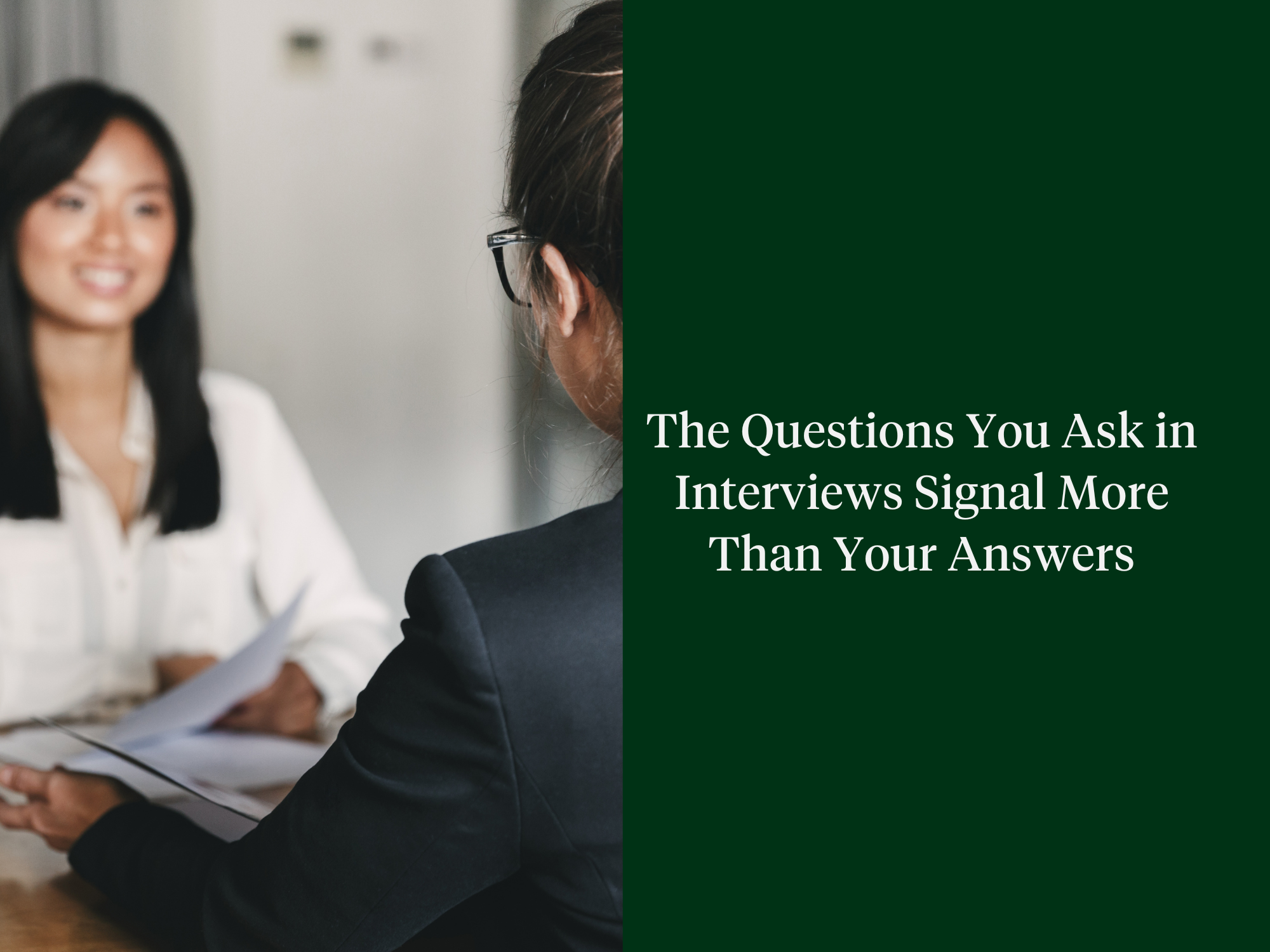
The Questions You Ask in Interviews Signal More Than Your Answers
Most job seekers spend the bulk of their interview prep perfecting answers.
They practice telling their story. They refine examples. They anticipate curveballs. All of that matters. But there’s a quieter signal many candidates underestimate: The questions you ask.
In interviews, questions aren’t a formality or a box to check at the end. They’re data. They tell interviewers how you think, what you value, and how you understand the role you’re stepping into. Often, they reveal more about your readiness than your answers do.
Especially early in your career, this is one of the clearest ways to demonstrate judgment without overstating experience.
Why Interview Questions Matter So Much
Interviewers are evaluating whether you can do the work and trying to understand how you’ll operate inside their system.
Your questions help them assess:
Whether you understand how work actually happens, not just how it’s described
Whether you’re thinking beyond your own tasks and toward outcomes
Whether you’re evaluating fit intentionally or simply hoping to be chosen
Strong questions signal curiosity, awareness, and strategic thinking. Vague or surface-level questions often signal uncertainty or passivity, even if your answers are solid.
This isn’t about asking “impressive” questions. It’s about asking informed ones.
What Weak Questions Usually Signal (Even When Unintentional)
Questions like:
“What does a typical day look like?”
“What’s the company culture like?”
“What opportunities for growth are there?”
These aren’t bad questions, but when they stand alone, they often signal that the candidate hasn’t yet thought deeply about how the role functions or what success looks like.
They keep the conversation general when interviewers are listening for specificity.
What Strong Questions Actually Do
Strong interview questions do one or more of the following:
Clarify how success is defined
Surface decision-making dynamics
Reveal how teams collaborate and resolve tension
Signal that you’re already imagining yourself contributing
Here are a few examples of questions that do that work quietly and effectively.
Instead of: “What does success look like in this role?”
Try: “What outcomes would you want someone in this role to be driving in their first six months?”
This shifts the focus from abstract success to concrete expectations.
Instead of: “How does the team work together?”
Try: “How do decisions typically get made when there are competing priorities?”
This signals that you understand tradeoffs are part of real work.
Instead of: “What are the biggest challenges of the role?”
Try: “What tends to be hardest for people when they first step into this role?”
This invites honesty and shows you’re preparing, not posturing.
Questions as a Positioning Tool
Early-career professionals often feel pressure to prove they belong. Questions can help reframe that dynamic. When you ask thoughtful questions, you’re not asking for permission. You’re participating as someone who expects to engage with complexity.
That’s a subtle but powerful shift.
You don’t need to ask many questions. Two or three well-chosen ones are enough. What matters is that they reflect how you think about work, responsibility, and growth.
How to Prepare Your Questions Intentionally
Before an interview, spend ten minutes on this exercise:
Read the job description and identify what the role is actually responsible for, not just what it lists.
Ask yourself what would make this role succeed or struggle in its first year.
Write down two questions that would help you understand that reality more clearly.
If your questions could be asked of any company, they’re probably too broad. Aim for questions that could only apply to this role, this team, or this organization.
Think of interviews not as performances but as working sessions.
Your answers show what you’ve done. Your questions show how you’ll think. And for early-career job seekers, that signal can make all the difference.
If you leave an interview feeling like you understood the role more clearly than when you arrived, you likely asked the right questions.
