
Women’s History Month: Building STEM Careers for the Long Game
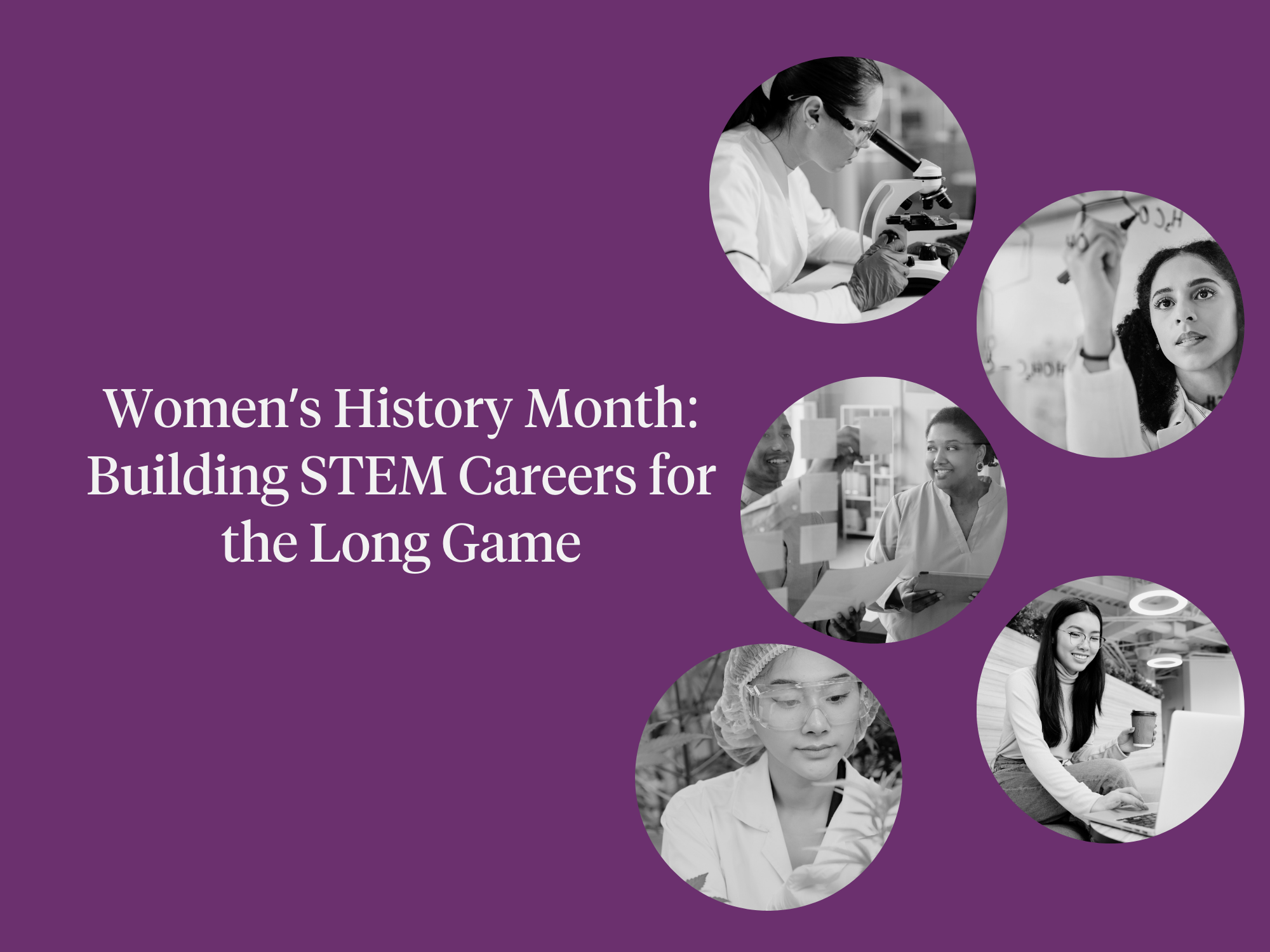
Women’s History Month is often framed as a celebration of breakthroughs and firsts. The first woman to do this. The first woman to lead that. The first woman allowed into rooms that were never designed with her in mind.
Those stories matter. They remind us how much progress required persistence, courage, and collective effort.
But for many early-career women in STEM today, the challenge looks quieter. It shows up as being competent but overlooked. Being included but not always heard. Growing technically while still learning how to navigate environments that were not built with their experiences in mind.
Women are entering STEM fields in higher numbers than ever before, yet representation and advancement still tell a more complicated story.
Women earn nearly half of all STEM degrees in the United States, but make up roughly 28% of the STEM workforce overall, with even lower representation in engineering and technical leadership roles. Women of color remain significantly underrepresented, particularly in senior and decision-making positions. Studies also show that women leave STEM careers at higher rates than men, often citing workplace culture, lack of advancement pathways, and limited mentorship or sponsorship.
The issue is sustainability.
Visibility, Growth, and the Long Arc of a Career
Early in a STEM career, success is often defined by technical mastery. Learn the tools. Deliver strong work. Be reliable.
And many women do exactly that.
Yet visibility and advancement do not always follow performance automatically. Research consistently shows that women are more likely to be recognized for diligence and teamwork, while men are more frequently associated with leadership potential or strategic thinking. Over time, those subtle differences compound. The result is not a single barrier but a series of small misalignments:
Strong contributors brought in late instead of early
High performers trusted with execution but excluded from decision-making
Talent recognized privately but not advocated for publicly
This is why Women’s History Month is not only about honoring pioneers. It is also about equipping the next generation to build careers that endure.
Because success in STEM requires an ecosystem built over time.
Celebrating the Women Who Expanded the Path
Every generation of women in STEM has expanded what is possible, often without recognition in the moment.
From mathematicians like Katherine Johnson whose calculations shaped space exploration, to engineers, scientists, designers, analysts, and technologists quietly solving complex problems today, progress has always been collective.
Many of the women shaping STEM right now will never be labeled “trailblazers.” They are mentors answering late-night questions, managers advocating for junior colleagues in promotion meetings, and early-career professionals choosing to stay, grow, and lead even when the path feels uncertain.
Their impact is cumulative. And it matters.
Playing the Long Game in STEM
If you are early in your career, Women’s History Month can also be a moment to shift perspective. Instead of asking “How do I succeed quickly?” a more useful question may be: How do I build a career that keeps expanding over time?
Here are a few ways to set yourself up for the long game.
Build Skills and Context: Technical expertise opens doors. Understanding how your work connects to business outcomes keeps them open. Learn not only how systems function, but why decisions are made around them.
Make Your Work Legible: Practice explaining what you do, why it matters, and what changed because of your contributions. Visibility is not self-promotion; it is communication.
Invest in Relationships Early: Careers accelerate through networks of trust. Build relationships with peers, mentors, and collaborators long before you need support. Community is not a bonus feature of a career. It is infrastructure.
Track Your Growth: Keep a record of projects, wins, lessons learned, and measurable outcomes. Early careers move quickly, and memory fades faster than progress. Documentation builds confidence and prepares you for opportunities.
Define Success Broadly: Leadership in STEM does not look one way. Some lead through research. Others through management, design, operations, education, or entrepreneurship. Allow your definition of success to evolve as you do.
Women’s History Month reminds us that progress is built through sustained participation.
Every woman who stays curious.
Every woman who asks a question in the meeting.
Every woman who mentors someone coming behind her.
Every woman who chooses growth even when certainty feels far away.
The history being celebrated this month is still being written. And for early-career women in STEM, the goal is to shape it, strengthen it, and remain within it long enough to lead.
Your career does not have to unfold perfectly to matter. You deserve support, sponsorship, and opportunities. And as we continue to build what comes next, may you remember: simply showing up, speaking up, and staying the course are acts of history in motion.
