
Meet Avni Mohan, 2026 AdaMarie Fellow
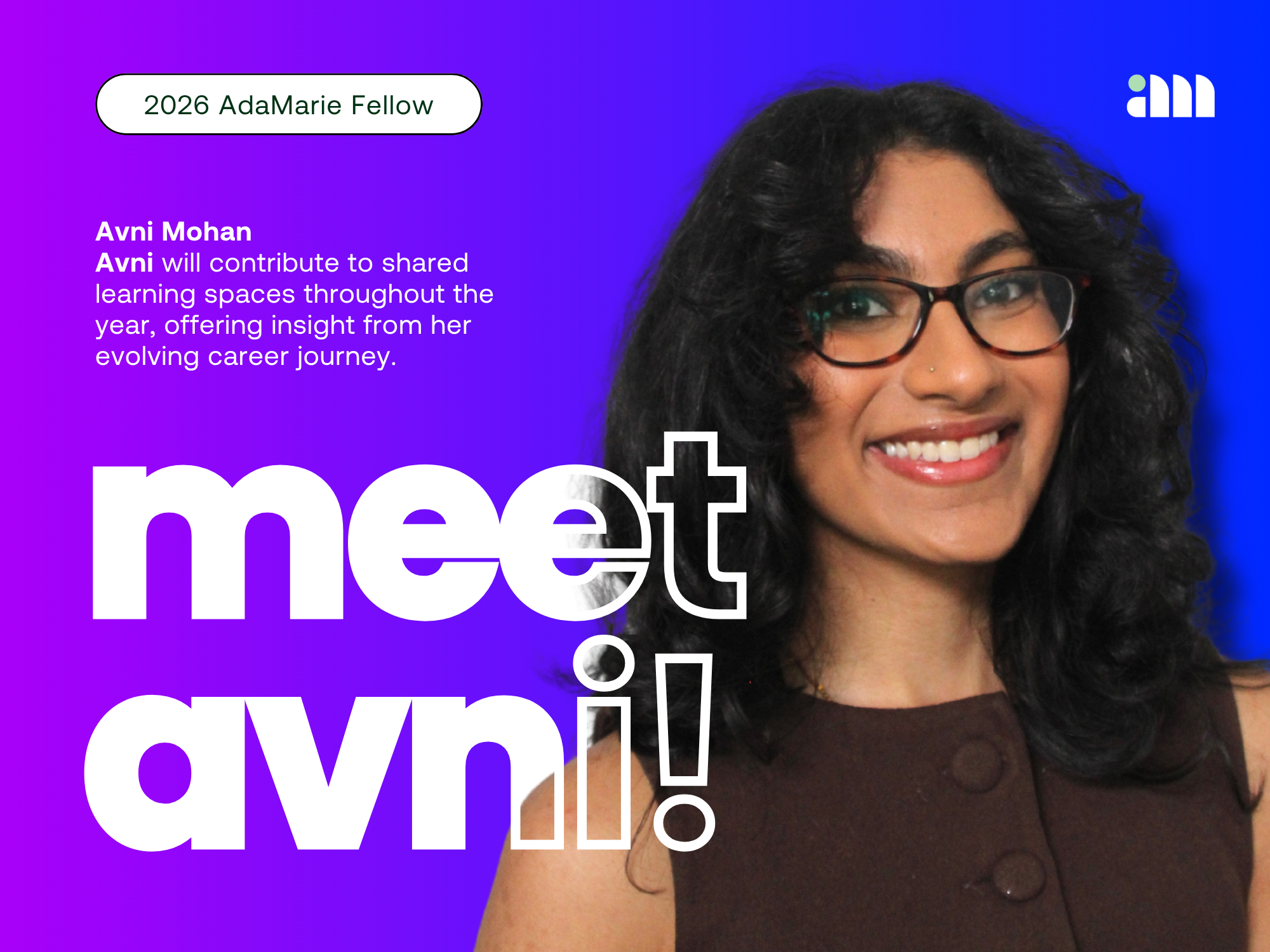
Meet Avni Mohan, an AI Engineer Intern and emerging technologist whose work sits at the intersection of machine learning, business insight, and real-world problem solving. Trained in computer science and shaped by early experiences in genomic research, Avni’s path reflects a willingness to explore, pivot, and build across disciplines rather than stay confined to a single lane.
Her journey moves between data science, consulting, and research, grounded in a curiosity about how technology can be applied beyond theory to create meaningful impact. From analyzing business operations to exploring machine learning in epidemiology, Avni is building a career that connects technical depth with practical application.
Throughout her work, she brings a perspective shaped by both technical rigor and creative exploration, approaching problems with a systems mindset and an openness to learning across industries.
In this Mirror, Avni shares how burnout, curiosity, and interdisciplinary thinking shaped her path into AI and data science, and how she’s learning to build a career that doesn’t require choosing between her interests. Keep reading to explore how she navigates growth, balance, and the evolving possibilities of technology.
Meet Avni Mohan!
Major & Minor – If you went to college!: Computer Science
Field of Work: Software Engineering
Expertise In: Data Science and Machine Learning
Job Title: AI Engineer Intern
One-liner about what you’re working on: Using machine learning to solve real-world problems, whether that's streamlining a small business or healthcare usage patterns.
Currently geeking out over: Computational photography! There is so much that goes into seeing an image on your screen.
STEM hero (alive or dead!): Dr. Fei-Fei Li challenged the AI status quo by betting on data over algorithms, building ImageNet, the dataset that laid the foundation for modern machine learning.
Tell us about your professional journey – how did you get where you are now?
My journey started in genomic analysis, where I first got to explore machine learning in a research context. From there I pivoted more broadly into computer science, but quickly realized that traditional software engineering wasn't quite the right fit for me. An internship confirmed that, I found myself wanting to work on something a little different.
That something came in the form of a project with a small business, where I got to use my data science skills to help them understand their processes and streamline operations like shipping. Seeing how technology can have a tangible impact that technology could have in a business context was a turning point, it made me want to learn more about how technology can be intersectional.
So I started exploring more. I joined a business consulting club on campus, which opened my eyes to business operations, research, and problem-solving outside of a purely technical lens. Around the same time, I started sitting in on meetings at a research lab on campus to learn how that world worked, and eventually got to contribute to a project there. That experience reignited my interest in machine learning and led me to where I am now: researching applications of machine learning in epidemiology.
I also took a step toward entrepreneurship by joining a women's entrepreneurship club, which deepened my understanding of how technology and STEM ideas can be turned into meaningful real-world impact. All of these threads are coming together in what I'm doing today, pursuing my master's in computer science while interning at an AI startup, where I get to build on everything I've learned so far and continue growing as a professional.
We’re also curious to know your personal story and upbringing. What has made you “you”?
I'm the daughter of two software engineers turned entrepreneurs, so I grew up immersed in that world, and it's the path I'm currently pursuing myself. Alongside that, I grew up doing a lot of art, science, and reading, a little bit of everything, which reflects who I am today. I'm drawn to the intersection of technology with other disciplines.
Right now, I'm exploring how to leverage technology for business insights and decision-making, and I'm also deeply interested in the intersection of computer science, specifically machine learning, and biology. I've worked on genomic research in the past and am currently working on machine learning in epidemiology, and I'm always curious about how to bring technology into new industries and spaces.
We know that real life isn’t a smooth and linear journey. What was your initiating moment that led you to your calling - can you tell us about that moment, what helped you moved forward, what you learned/discovered?
At one point in my academic career I found myself burned out by computer science. Taking multiple programming-heavy courses back to back left me exhausted, so I decided to take a break from traditional software engineering and spent a summer interning as a business analyst. Using my data science and software skills, I conducted in-depth analysis for a business and got to see firsthand how technology can help small businesses improve their processes and pricing models. It gave me a new lens for my skill set.
From there I joined my campus' business consulting club, where I worked on client projects that let me blend both sides of my background, using statistical analysis to deliver marketing insights for one client, and leveraging my technical knowledge to research data center technology and provide business recommendations for another. These experiences showed me that I didn't have to choose between my interests. That realization is what led me to explore machine learning in epidemiology and construction, and it's the intersection I hope to keep building on.
You’re a working person in a performance-driven industry. Where do you find balance?
As someone who constantly finds herself working on extremely technical projects all the time, I find that my creative hobbies are a good way to activate the right side of my brain. I enjoy crocheting, scrapbooking, traveling, and photography. Sometimes I just need to sit back and relax after balancing my classes, work, and research.
I love talking to friends, family, and honestly anyone I cross paths with, I've had hour-long conversations with complete strangers and almost always walked away having learned something, even if it had nothing to do with my career. I also stay balanced by reading about industries and fields outside of STEM. Diversifying what I take in keeps me from feeling like I’m stuck in a box.
Let your geek flag fly! You choose one: if you were a part of the human body, outer space, or a scientific process, what would you be and why?
I would love to be the hypothalamus in the brain. The hypothalamus is known for regulating sleep (which I am a big fan of), but it is also important for keeping your body in a stable state. It reacts to chemicals in the body and regulates balance through the entire body. I try to include a lot of balance in my life, and am therefore grateful for my hypothalamus.
We’d love to feature your work! How can we spread the word about what you’re doing? Some examples you might want to share:
You can check my LinkedIn.
Do you have a favorite motivational quote or song?
One of my favorite songs in Thank U, Next by Ariana Grande. I love the central message of being able to hold gratitude for experiences and being able to move onto the next chapter. This is a mentality I like to have in my life, for both the good and bad experiences.
Any final advice for early-career STEM professionals?:
Burnout is real and something I have faced in the past. In these difficult moments, it's important to find balance and ways to calm yourself down. STEM professions can be a demanding field, so it's always important to make sure that we take moments to take a deep breath and reflect.
That same mindset has shaped how I approach setbacks more broadly. Being able to get up after falling is important, I think every mistake is a learning opportunity, and it is important to reflect on both successes and failures. I have had a fair share of both, and while it's easy to get stuck on the failures, it's important to treat them as learning experiences and come back stronger.
Avni’s journey reminds us that careers don’t have to be linear to be meaningful; they can be built through exploration, experimentation, and a willingness to follow what sparks your curiosity.
As she continues to grow at the intersection of machine learning, data science, and real-world application, Avni brings a perspective rooted in both technical depth and interdisciplinary thinking. Follow along to learn from her work, her reflections, and the ways she’s shaping a path that connects technology, impact, and possibility.
