
Build Proof, Pick a Niche, Get Visible: Advice for Early-Career STEM Professionals
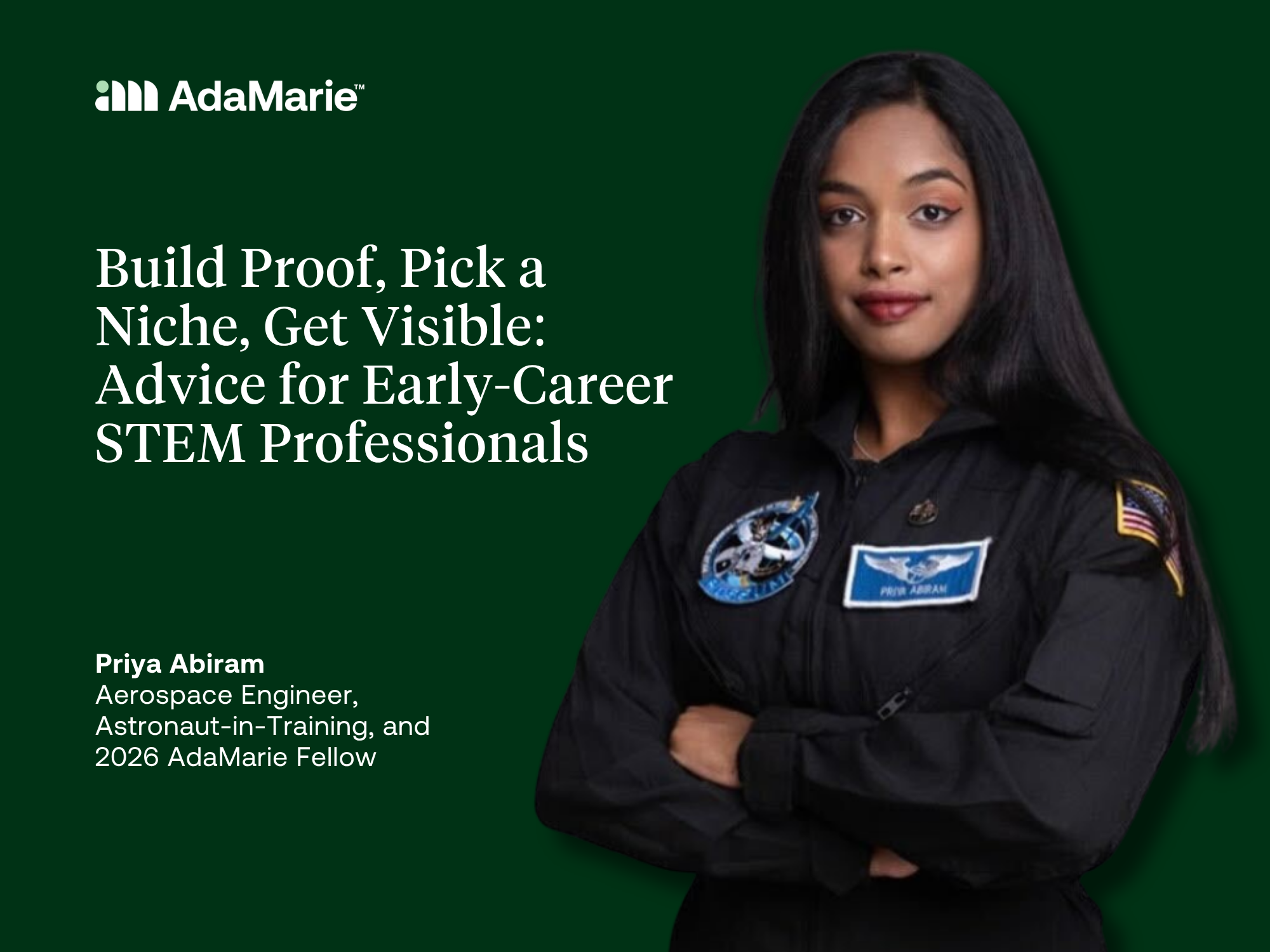
Early in your career, it is easy to think aerospace is a closed world. You imagine a pipeline full of perfect resumes, brilliant engineers, and people who somehow knew exactly what they wanted to do from the beginning. But that is not what I have seen. What I have seen is an industry in one of the most exciting growth periods in history, and at the same time, one that still has real gaps in access, imagination, and design.
Opportunity No Longer Belongs to One Path
One of the biggest early-career trends I notice is that opportunity no longer belongs only to the traditional path. New space companies are being built every day. The work is no longer limited to one government agency or one archetype of engineer. There are roles in operations, business development, policy, manufacturing, human systems, media, design, supply chain, medicine, research, and more.
That matters, because the future of space will not be built by one kind of person. It will be built by people who know how to solve real problems and move ideas into the world.
Build Proof, Pick a Niche, Get Visible
That is why I always come back to the same advice for early-career people trying to break in: build proof, pick a niche, and get visible.
Too many students are still taught to wait. Get the grade. Get the degree. Submit the application. Hope someone notices. But some of the most meaningful opportunities in my own career began when I stopped waiting to be chosen and started building undeniable value.
That was the first rule in my TEDx talk. When you build your own door, you do not just walk through it. You hold it open.
The Next Bottleneck is Human
At the same time, there are still serious gaps in this industry. Some are cultural. Some are technical. We still have environments where young people, especially women and underrepresented students, are asked to prove themselves twice before they are taken seriously. We still have systems that quietly decide whose work counts. And in space, those blind spots do not just affect culture. They affect engineering. One of the most important ideas in my TEDx talk was that the next bottleneck is not metal, it is biology. We have gotten very good at sending machines into orbit. We are still learning how to fully support every human inside them.
This is also why I care so deeply about the question people love to ask: why spend money on space when Earth has problems? Because space is not separate from Earth. Space is where we pressure-test solutions to air, water, energy, waste, medicine, and survival. The discipline of designing for extreme environments teaches us how to live better here too.
Designing What Comes Next
For early-career people, that is the opportunity. Aerospace is not just about rockets. It is about building what comes next. The challenge now is to make sure the next generation does not just inherit this future, but helps design it.
Priya Abiram is an aerospace engineer, pilot, and astronaut-in-training whose work spans human systems engineering, spacecraft design, bioastronautics research, and women’s health innovation. A 2026 AdaMarie Fellow, she holds both a B.S. and M.Eng. in Aerospace Engineering from Cornell University and has contributed to projects and research with organizations including NASA, Blue Origin, Boeing, VAST, and Inversion Space.
Priya is passionate about designing systems that improve human performance in extreme environments while expanding access, representation, and possibility within STEM.
