
#AskAdaMarie: Is What You Are Already Doing Leadership? Yes. Here Is How to Grow It.
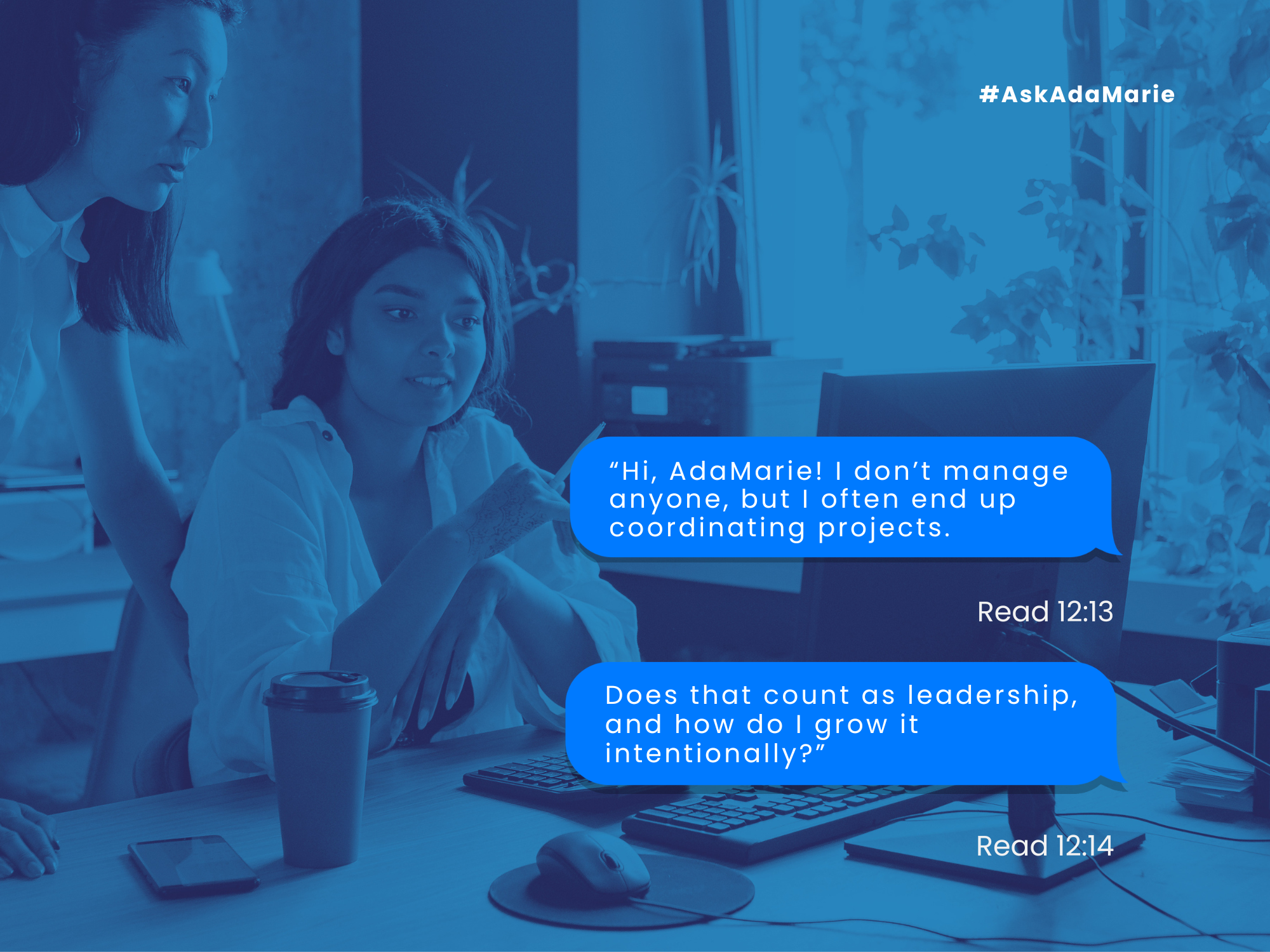
“Hi, AdaMarie! I don’t manage anyone, but I often end up coordinating projects and supporting teammates. Does that count as leadership, and how do I grow it intentionally?”
This question came in through #AskAdaMarie from a professional navigating one of the most common and least talked about career moments — the space between doing the work and being officially recognized for leading it.
Dear Already Leading,
Yes. What you are describing is leadership.
Not leadership-adjacent. Not a precursor to leadership. Not something that will count as leadership once someone gives you a title. Leadership, right now, in the work you are already doing.
Here is what I want you to understand about the framing of your question: you asked whether coordinating projects and supporting teammates "counts." And I want to gently push back on that word, because it implies there is someone somewhere keeping score, deciding whether your contributions are officially leadership or merely organizational helpfulness. There is not. What counts is whether the people around you are moving better, thinking more clearly, and feeling more supported because of how you show up. And from what you have described, they are.
That is leadership.
What you are actually doing
Coordination sounds administrative. It is not. When you coordinate a project, you are holding multiple people's priorities in your head simultaneously. You are anticipating conflicts before they surface. You are translating between different communication styles and working preferences. You are making judgment calls about what matters and what can wait. You are keeping things moving when momentum starts to stall.
That requires emotional intelligence, systems thinking, communication skill, and the ability to influence people who do not report to you which is, arguably, a harder form of leadership than managing a direct report. Anyone can assign tasks. What you are doing is much more nuanced than that.
Supporting teammates is also not a soft contribution. It is often the thing that determines whether a team performs at its ceiling or settles somewhere below it. The person who makes others feel seen, capable, and supported is doing culture work and culture work is leadership work, full stop.
Why it might not feel like leadership yet
There is a particular kind of invisibility that comes with the kind of leadership you are describing. Because you do not have formal authority, the impact of what you do is harder to point to. You cannot say "I managed a team of five." You have to say something more like "I supported the conditions under which five people did their best work," and that is a harder sentence to write on a resume, harder to claim in a performance review, and harder to recognize in yourself.
But the gap between doing the work and being recognized for it is not a sign that the work does not count. It is a signal that you need to get better at making it visible.
How to grow it intentionally
The first thing is to name it to yourself and to others. When you wrap up a project you coordinated, reflect on what you actually did. Not just the tasks. The decisions you made. The conflicts you navigated. The moments where your steadiness kept things on track. Write those down. They are your leadership evidence, and you will need them.
The second thing is to start framing your contributions in leadership language. Not to overstate, but to accurately describe. "I coordinated the project" becomes "I led cross-functional coordination across three teams." "I supported my teammates" becomes "I identified gaps in how information was flowing and built informal structures to address them." Same work. More accurate language.
The third thing is to get intentional about the skills that will help you lead more effectively in this space. Influence without authority. Facilitation. Conflict navigation. Clear communication under pressure. These are not soft skills. They are the skills that determine whether people follow you before you ever have the power to require it.
And the fourth thing — maybe the most important — is to find at least one person who can see you clearly and speak to what you are building. A mentor, a manager, a peer who has watched you work. The story of your leadership will need witnesses, and it helps to cultivate relationships with people who can tell that story alongside you.
The professionals who grow into the most effective formal leaders are almost always the ones who took their informal leadership seriously first.
Who treated every coordination opportunity as a chance to practice influence. Who showed up for their teammates not because it was required but because it was the right thing to do. Who built credibility quietly and consistently, long before anyone put a title behind their name.
That is you.
You are already leading. Now lead with intention.
With you,
AdaMarie
Have a career question you have been sitting with? Submit it using #AskAdaMarie and we may feature it in an upcoming post. AdaMarie is a professional network built for early-career and career-changing STEM professionals.
