
Mirrors: Yesenia Perez, Senior Informal Education and Outreach Specialist
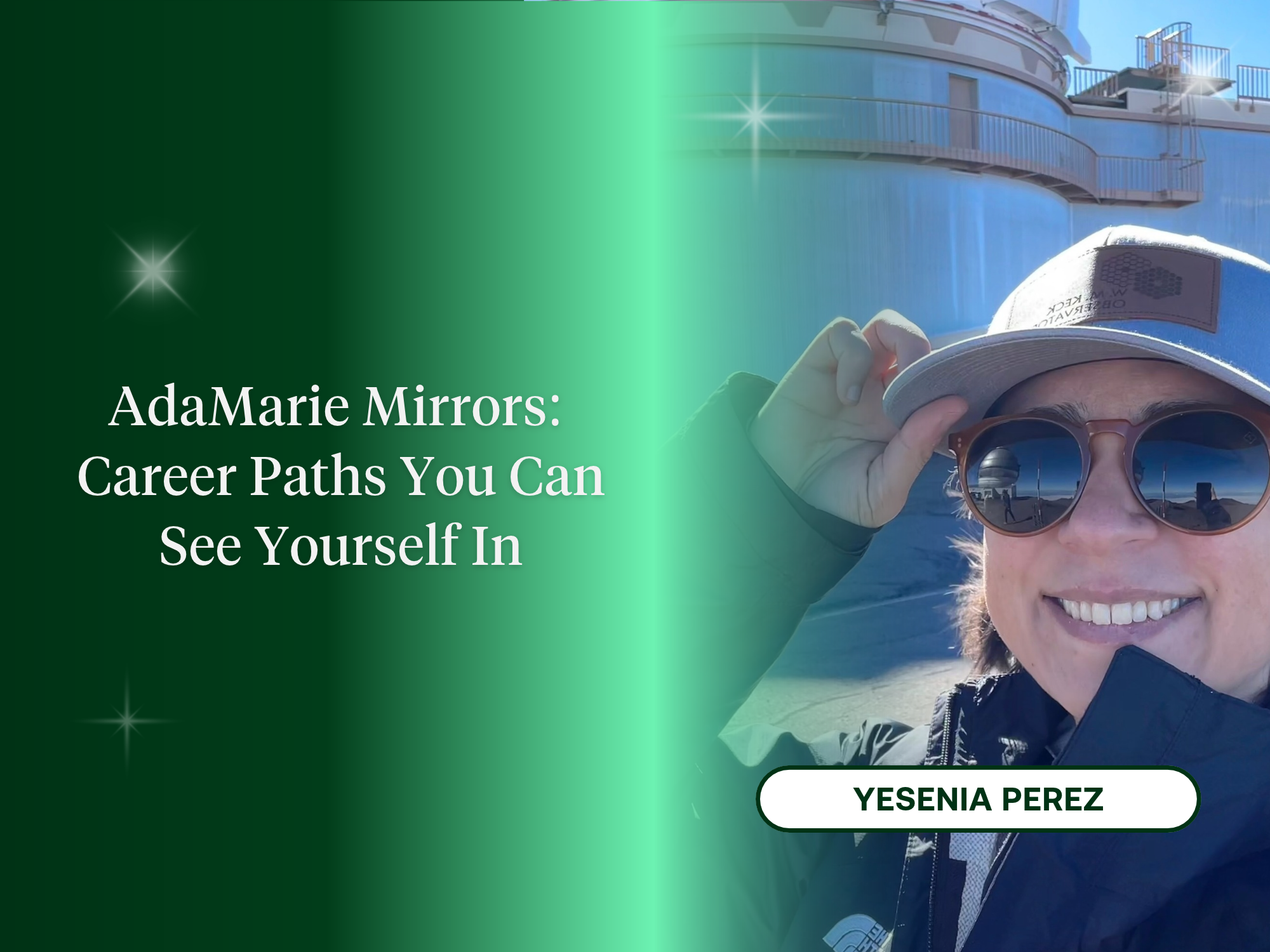
The AdaMarie Mirrors reflect back to us the many roads (often winding, never smooth) to success! Real stories to see yourself reflected. At first, you’ll see Yesenia in this mirror, but eventually, we hope you’ll see yourself.
Welcome, Yesenia Perez!
Yesenia Perez’s career didn’t begin in space science; it began in art museums.
With a background in art history, architecture, religious studies, museum studies, and educational leadership, Yesenia has followed a career that has crossed disciplines but stayed connected by one question: how do we help people see themselves in spaces built around knowledge and discovery?
Today, she’s a Senior Informal Education and Outreach Specialist at the Space Telescope Science Institute, where she works on public engagement and education connected to NASA missions including Hubble, Webb, and the Nancy Grace Roman Space Telescope. Her work brings together science, education, communications, partnerships, and community, with a focus on making complex ideas something people can enter with curiosity rather than a prerequisite.
In this AdaMarie Mirror, Yesenia reflects on the winding path that brought her from museums to space science, what curiosity has taught her about building a career, and why being multidimensional can be one of the most valuable things you bring to your work.
Major & Minor – If you went to college!: History of art and architecture, religious studies/major, minor for undergrad, museum studies for my MA, and educational leadership in higher ed for my EdM
Field of Work: Space science education
Expertise In: Informal learning, lifelong learning, higher education, public speaking, outreach and community
Current Company: Space Telescope Science Institute
Job Title: Sr. Informal Education and Outreach Specialist
One-liner about what you’re working on: Cosmology and dark matter science explainer for NASA
Currently geeking out over: Black holes, the recent launch of the Roman space telescope, and any new images of our solar system
STEM Hero: Nancy Grace Roman/all women working for NASA.
Tell us about your professional journey – how did you get where you are now?
My professional journey makes much more sense looking backward than it ever did while I was living it.
I started in art museums, working in curatorial and education spaces and learning how much thought goes into the way people encounter an idea, an object, or a story. Over time, I became less interested in simply delivering information and more interested in the systems around learning: Who gets invited in? Who feels like something is “for them”? What makes curiosity possible?
That eventually carried me from museums into science education and public engagement. For the past several years, I’ve worked at the Space Telescope Science Institute, supporting NASA science missions including Hubble, Webb, and Roman. My work sits at the intersection of education, audience strategy, informal learning, communications, partnerships, and science. I’ve helped build national networks of museums and community organizations, develop public-facing science experiences, and translate incredibly complex science into something people can enter with curiosity rather than a prerequisite.
Along the way, I also returned to school and earned my master’s at the Harvard Graduate School of Education. That experience gave me language and theory for questions I had been asking throughout my career about institutions, belonging, leadership, and who gets to participate in discovery.
The thread through all of it is translation. I like standing between worlds and helping them understand one another: scientists and educators, institutions and communities, big ideas and actual human beings.
We’re also curious to know your personal story and upbringing. What has made you “you”?
I was a deeply curious kid, although I don’t think I always understood curiosity as a strength.
I asked a lot of questions. I noticed things. I could disappear into a subject for hours and then suddenly want to understand something completely different. As a first-generation college student, I also spent a lot of my early life learning how to navigate spaces whose rules weren’t always obvious to me.
That combination has shaped me more than almost anything else: curiosity paired with observation.
I’m fascinated by how people make meaning, how institutions communicate what they value, and how small signals can tell someone whether they belong somewhere. I think that is partly why I found my way first into museums and eventually into science education. Both are places where enormous ideas meet ordinary human experience.
I’ve also learned that being multidimensional is not something I need to edit out of myself. I can love research and storytelling. I can care about rigor and beauty. I can be strategic and deeply human. For a long time, I thought professionalism meant choosing one version of yourself and becoming very good at performing it. I’m much more interested now in integration.
We know that real life isn’t a smooth and linear journey. What was your initiating moment that led you to your calling - can you tell us about that moment, what helped you moved forward, what you learned/discovered?
I don’t think I had one cinematic lightning-bolt moment. Mine was more like a constellation. Eventually, enough points connected that I could see the shape.
One of the earliest points came during my museum work. I began to notice that the same exhibition could feel completely different depending on how someone was welcomed into it. A question from a docent, a piece of interpretation, a conversation with an educator, or even the way a room was designed could turn something intimidating into something someone suddenly felt connected to.
That fascinated me.
I realized I wasn’t only interested in what people learned. I was interested in what made them willing to approach something in the first place.
That question followed me into science. Space science can feel enormous, technical, and very far removed from everyday life. But the moment someone realizes, “Wait, I can understand this,” something shifts. They begin asking their own questions.
That has become a kind of north star for me.
The other lesson has been that a calling does not necessarily arrive as a job title. Mine certainly didn’t. It emerged through years of paying attention to the work that made me feel most useful and most alive. Sometimes moving forward has meant trusting that pattern before I could fully explain it.
You’re a working person in a performance-driven industry. Where do you find balance?
I’ve had to completely rethink what balance means.
For a long time, I treated rest as something I earned after everything was finished. The problem, of course, is that everything is never finished. There is always another project, another email, another opportunity to make something 10 percent better.
Now I think more in terms of rhythm than balance.
There are seasons when work asks a lot of me, but I try not to let productivity become the only measure of whether a day mattered. I protect time for writing, music, being outside, cooking, long conversations, baths, my cats, people I love, and occasionally doing absolutely nothing useful.
I’m also learning to notice myself earlier. I’m very capable of becoming completely absorbed in work I care about, so balance sometimes means interrupting my own momentum before exhaustion has to do it for me.
I’m still practicing that one.
Let your geek flag fly! If you were a scientific phenomenon, what would you be?
Gravitational lensing.
Mass can bend spacetime, which means something massive between us and a distant object can actually bend and magnify the light coming from behind it. Suddenly, something too faint or distant to see clearly becomes visible.
I love that.
A lot of my work is essentially about changing the conditions around an idea so more people can see it. The science itself hasn’t become less sophisticated. You’ve simply created another way into it.
And philosophically, I’m fascinated by the idea that perspective can reveal information that was there all along. Also, after years of working around astrophysics, I feel obligated to choose something appropriately cosmic.
We’d love to feature your work! How can we spread the word about what you’re doing?
Much of my work centers on making science and learning more accessible, participatory, and meaningful outside traditional classrooms.
At the Space Telescope Science Institute, I’ve worked across public engagement efforts connected to NASA’s Hubble, James Webb, and Nancy Grace Roman space telescopes, including national partnerships with museums, science centers, libraries, and other informal learning organizations.
I’m especially interested in how we build networks rather than one-time programs: creating structures that allow educators and communities around the country to participate in major moments of scientific discovery.
I also write and speak about education, institutional change, belonging, leadership, and the strange and wonderful work of translating expertise across disciplines. A selection of my work and current projects can be found at: yeseniaperezfina.github.io
And I’m always happy to connect with people thinking about education, science engagement, strategy, museums, philanthropy, or the spaces where those worlds collide.
Do you have a favorite motivational quote or song?:
One question I return to often is from Mary Oliver: “Tell me, what is it you plan to do with your one wild and precious life?” I love that it is a question rather than an instruction. It leaves room for the answer to keep changing.
Any final advice for early-career STEM professionals?
Don’t become so focused on proving that you belong in STEM that you stop noticing what you uniquely bring to it. Technical expertise matters enormously. So do communication, empathy, imagination, cultural awareness, relationship-building, teaching, storytelling, design, and the ability to ask a surprisingly good question. Some of the most interesting careers happen in the spaces between established disciplines.
I would also resist the pressure to make your career look perfectly linear.
Pay attention instead to the questions you keep returning to, the problems people consistently ask you to help solve, and the kind of work that leaves you tired but still curious. And find people who are generous with what they know. You do not need to know everything before you enter the room. You do need to stay willing to learn once you’re there.
