
Your Career Plans Don't Need a Crystal Ball
So, you started working in the last few years. Maybe you spent years getting some education or time in a tech boot camp. You’ve come a long way to get to this point, and that matters.
Sometimes a thought pops in your head. Maybe it comes from you, or maybe you’ve heard people ask it: “What do I want to be doing in 5 years (or some number of years)?”
How are you supposed to answer that question when you don’t have a crystal ball, and neither do the people you talk to?
No crystal ball needed. Here are 10 things that can help.
1. Define and Document Your Goal(s)
Many people are not able to articulate their goals. Start by defining yours, and make sure they’re truly your goals, not someone else’s.
Can you describe your goal if someone asks? If not, refine it until you can. And don’t forget about writing it someplace you’ll see it often. This could be a post it note, a doc, or a vision board, whatever works for you. Your later-self will thank you.
2. Make a Plan, From Which You Might Deviate
As the saying goes, “A goal without a plan is just a wish.” Now that you have your defined goal, make a plan to support it. It doesn’t have to be super-detailed, but it should be concrete enough for you to understand later or to share with a mentor or colleague.
Also realize that this is a plan, reality will happen and things might change. You might deviate from it. That’s okay. It’s ok not to be tied to the specifics of the plan.
3. Revisit Your Goals and Progress
It helps to revisit the goals and plan to see how you’re progressing towards them. During this reflection time, confirm that the goals and plan are still relevant.
How often should you revisit? It depends on your timeline, but I’d recommend at least every three months.
4. Know That Success Is Not a Straight Line
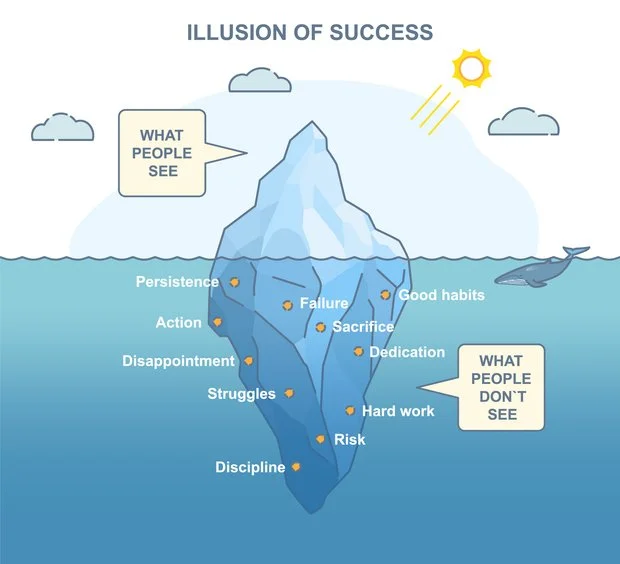
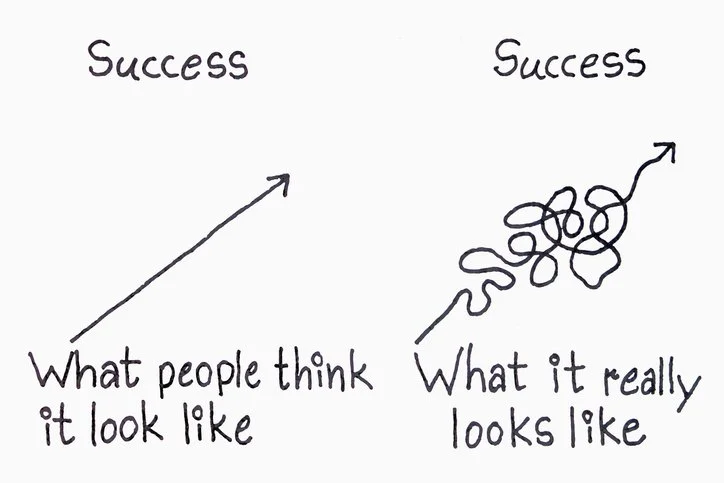
Success is not a straight line, and not even an upward line. There will be peaks and valleys and so much invisible work that doesn’t always show up on the highlight reel.
I could say much more here but two images capture it better.
5. Approach Decisions Wisely
Most decisions are not one-way doors; they are two-way doors you can walk back through. That means you can often experiment before going all in.
For example, if you think you want to change what you do or make a career shift, can you find a way to try it out to see how you like it? Take on a side project, shadow someone, or dip your toe in to see how it feels.
And since no decision comes with guarantees, focus on the process over the outcome.
I literally have a reminder note above my monitor that says,“It’s about the decision or action, not the outcome. Don’t be tied to the outcome.”
6. Learn From Mistakes and Failures
Everyone makes mistakes, you’re human. What makes a difference is how you handle mistakes and failures, because they can both be powerful teachers.
So, when you make mistakes, or have failures (or feel you’re a failure), ask yourself what lessons you can learn from the experience. And try to remember those lessons in the future. As the famous saying goes: “Success is not final, failure is not fatal: it is the courage to continue that counts.”
7. Avoid the Comparison Trap
“Comparison is the thief of joy” is more than just a quote; it is a real risk to your well-being. Comparing yourself to others or to rigid plans isn’t great for your well-being. Instead, compare yourself to your past. I bet you’ll find growth there. And if not, it’s not too late to start.
8. Get Curious and Gather Data
Curiosity is a wonderful asset. Use curiosity to get information, and that information can inform decision-making. For example, if you know someone who is where you’re heading, talk to them to learn more.
9. Celebrate your wins
We do so many good things. For many of us, we ignore or downplay those things and hyperfocus on what we haven’t done. Celebrate your wins, big and small. I recommend doing this at least weekly, and I recommend writing them down so you can see your progress over time.
10. Remember the Full Picture
Whatever you are doing professionally in five years, it is extremely important that you are a healthy human being, and I’m talking about both physical health and mental health. Be sure you’re making time for the other things that matter in your life.
You just read all that, and still don’t have a crystal ball. But you do have a set of tips to navigate whatever comes next. Onwards.
Boomie Odumade is a 2026 AdaMarie Expert, bringing more than two decades of engineering leadership, coaching, and systems thinking to conversations with our community. Throughout the year, she’ll be joining AdaMarie for live discussions focused on career growth, leadership, and navigating evolving paths in tech.
Visit the AdaMarie Events Calendar to see upcoming live conversations and events featuring Boomie.
